
And they said unto me, The remnant that are left of the captivity there in the province are in great affliction and reproach: the wall of Jerusalem also is broken down, and the gates thereof are burned with fire. – Nehemiah 1:3
The Jewish polity had been in desolation since Nebuchadnezzar had destroyed the Kingdom of Judah and razed Jerusalem. They had now been relegated to a mere province within the Persian Empire. They were in a scattered condition. God had not forgotten them however. God, who has the hearts of kings in his very hand, had moved the heart of Cyrus to allow the Jews back into their promised land and to rebuild the Temple. God remained faithful to his covenant, and would sustain the people and body until the seed of the woman should enter upon the stage of the world, and establish a new and better covenant. Though they had been allowed back into the land of Judaea to rebuild the Temple, the wall and gates which had served as a defense to Jerusalem were in deplorable condition. The Jews, with enemies without, were in distressed condition. Worthy of pity and melancholy. Those familiar with the book of Nehemiah know that after supplications to their God for mercy and aid, they were able to repair the walls and reestablish the people in Jerusalem and Judea. Their efforts at shoring up their defenses and repairing their city were successful under the watchful eye and powerful aid of the Lord God.
By analogy, we of Congregational persuasion too are in an alike predicament. Our churches stand in a dilapidated condition and sad state. The walls are broken down, and the gates are burned with fire.
The Congregational churches stand in need of restoration, renewal, and revitalization. Repair is the order of the day. The need of restoration is evident if we consider the present state of her doctrine, her polity, and her relation with other conservative bodies of Protestants.
Proof 1: The doctrinal decay of her churches.
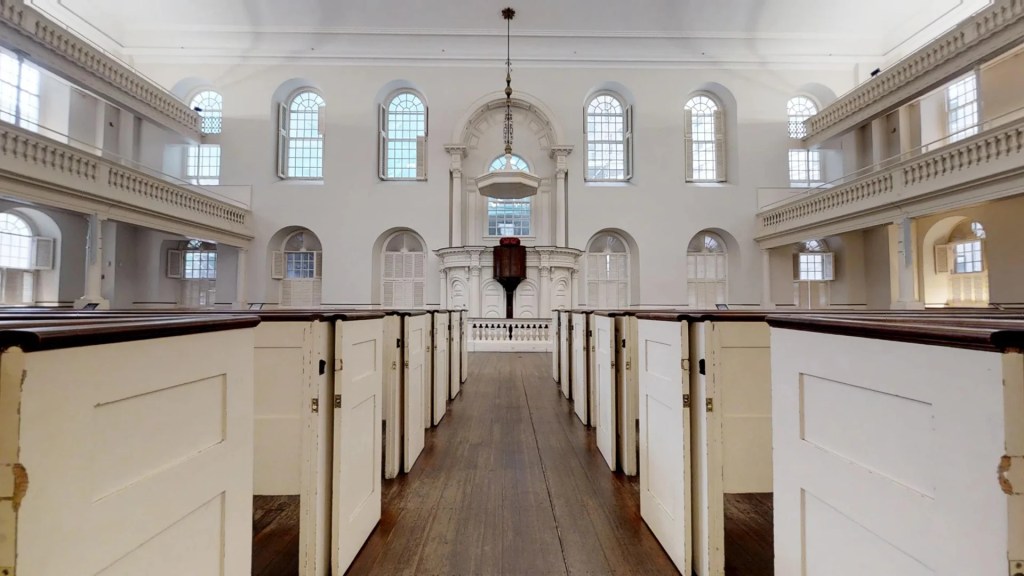
The land still bears witness to a once vibrant and vigorous Congregationalism. One can travel the stretch of land from Maine to Washington and happen across their elegant yet restrained steeples. Once impregnable centers of a vital doctrine and system, how their glory is much diminished. “How is the gold become dim.”[1] One searches nearly in vain to find churches faithful to their original. From the LGBTQ-adorned United Church of Christ, to the mega-church indistinguishable from the most bland and banal excesses of evangelicalism, there is little semblance to the historic Puritan pulpit and sanctuary.
In proof of this foregoing conclusion, one need only look at the state of doctrine. Excusing for a moment the liberal United Churches of Christ, whose only doctrine is acceptance and tolerance of sin, the average doctrine confessed by Congregational churches is largely paltry and meager. The curious inquisitor would be hard pressed to happen upon a Congregational church that confesses her historic Augustinian and Calvinistic heritage, much less make even a passing reference to the Savoy Declaration of Faith. The churches that do so confess are like the distant stars of the night sky; few and far between, hidden, and happened upon only by the most accidental of occurrences. Far too common are bullet point statements of faith, which bear enough latitude to allow both the Pentecostal and the Puritan in the pulpit. A more expansive confession is to be preferred. Latitude must give way to distinctness. A sturdy creed rather than flimsy. This is not to heap abuse upon churches that are largely faithful and maintain the fundamentals of a Christian profession. It is better to have a small faith than no faith. It is however to note the degree of doctrinal degradation from the full and plentiful faith of the virtuous and manly Puritans. Ours is a meager faith in comparison.
Proof 2: The lack of fidelity to her historic polity.
The genius of Congregational polity is that it asserts the completeness and sufficiency of the local and particular church. Within her walls she has all that is necessary for her organic and political life. This genius when overemphasized and disconnected from her duties and relations with other churches has frequently turned from a virtue into a vice. Too often do Congregational churches become atomized and individual. They are disconnected from the whole. They are more like the comet blaring through the ethereal heavens, rather than the compacted fleet pursuing a common good and end. Let’s not forget that our forefathers detested the name of “Independents” as alien to Congregational polity.[2] Even when supra ecclesial organizations are established, they exude more the aura of a glorified conference. Our spiritual forebears did not shy away from the language of synods and associations, nor were averse to predicating a certain divine authority to these. Only with the recovery of a thicker Congregationalism with rich connectionalism and consociationalism will we be able to unite our energies efficiently for the peace, purity, and edification of our churches.
Proof 3: Her condition relative to other conservative Protestant bodies.
Anglicans, Lutherans, and Presbyterians all have their denominations and institutions. ACNA, the PCA, OPC, the LCMS, and WELS all have their publishing houses, mission organizations, conferences, and union about an established confession and polity. Relative to these, Congregationalism stands in a particularly dilapidated condition. Congregationalism doesn’t even have the consolation of boasted numbers. Her section of the wall is not only fallen into disrepair, but is poorly manned. She has lost her confidence in her history, and as such has lost the will to fight for it. She must have the confidence of other denominations in asserting her peculiarities and recovering a renewed sense of her history.
The condition is bleak. The circumstances are dire. Danger surrounds us, and we are seemingly without hope. The Congregational man is a Christian however. He doesn’t put his hope in strength of arms and human instrumentalities. His sure and firm fortress is the Lord God, who has and will preserve his people in all ages. Though it seems as though there is little hope for renewal in the Congregational churches, there is a good, powerful, and wise Jehovah who reigns in the heavens. He blesses the earnest and honest endeavors of his people to reform and renew. The problems are enumerated, and the pathway to renewal is before us. It only remains to make a series of inferences from this present state of affairs.
- Inference 1: Revival of her historic literature. The first inference to be made is that we must return to the sources of Congregationalism. Ad fontes. In addition to being men of the Bible, the true fount of saving knowledge, we must return to those writings of men and churches that God raised up in their time to be a pattern for ourselves. Too long have the writings of Thomas Hooker, John Norton, John Cotton, Samuel Willard, and others been consigned to be merely the subjects of 20th century academic monographs. They must be injected into the life of modern Congregationalism. This means they must be republished so as to be readily accessible. Their theology is like a rich ore vein, long since lost, but a fruitful store of riches for those who would have them. It is only by returning to the good old paths that true renewal can occur.
- Inference 2: Revival of Education. Revival of her historic aptitude to education in the liberal arts, philosophy, and theology. The Congregationalism of our forefathers was a firm friend to human education and culture. We would be wise to cultivate this love of education in all its departments. We are the descendants of the same people who founded Harvard, Yale, and Dartmouth. The same people who mandated in 1647 that towns exceeding fifty people would “forthwith appoint one within their town to teach all such children as shall resort to him to write and read, whose wages shall be paid either by the parents or masters of such children.”[3] The same people that possessed a literacy rate second to none in the world of the 17th-18th centuries.[4] Learning has always been a friend and companion to religion. Because some have claimed learning and philosophy to be opposed and contradictory to true religion should not phase us. It is only a disordered conception of philosophy and learning that attempts to usurp or displace theology. Therefore it is necessary for us to cultivate a rich intellectual ecosphere in which all the branches of human learning can be studied and advanced, guided by the regal queen that is theology herself. She must ever be a friend to founding Christian classical schools, and even Christian colleges at which human learning can be advanced, theology and philosophy inculcated, and ministers trained up to enter preparedly into the vineyard.
- Inference 3: Associations and Consociations. The last inference to be concluded is the necessity of establishing sure and certain bonds among ministers, laymen, and churches. The first place to start is with informal connections. “Without friends no one would choose to live, though he had all other goods,” said the Philosopher.[5] Establishing connections with likeminded, virtuous, and wise men is requisite to a budding renewal movement. It is in these connections that bonds as strong as ligaments are established. The context in which ideas are refined into things of strength and beauty.We cannot rest content with merely informal connections however. Informal connections must bud and blossom into formal and ecclesial relations. The interests of Congregationalism demand movement toward firm and effectual union through associations and consociations. United action rather than disconnected anarchy. It is through this means that the present and future interest of Congregationalism will be most surely and certainly secured.The problems are many, and the dangers abound, but the Lord is a good God. He blesses the endeavors of his faithful servants. The Lord Jesus Christ reigns enthroned as king over his church, and the gates of hell shall not prevail against it. We can have hope that the best days of Congregationalism are yet ahead of us, but we must act and act now.
[1] Lam. 4:1.
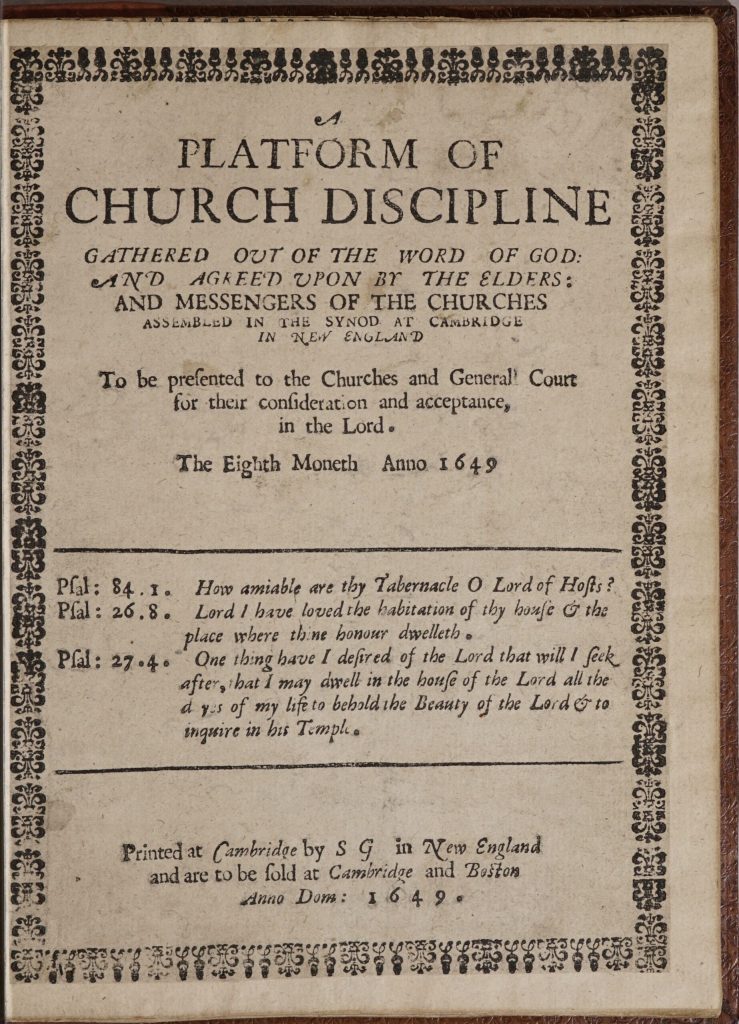
[2] “The term Independent, wee approve not.” See the Cambridge Platform; Williston Walker, Creeds and Platforms of Congregationalism (Boston, MA: Pilgrim Press, 1969), 205.
[3] See The Old Deluder Satan Law of 1647.
[4] As Kenneth Lockridge shows in his Literacy in Colonial New England, as much as 60% of New England was literate in the later 17th Century, and 90% by 1787.
[5] The Nicomachean Ethics, Book VIII, I.
 The Saybrook Platform