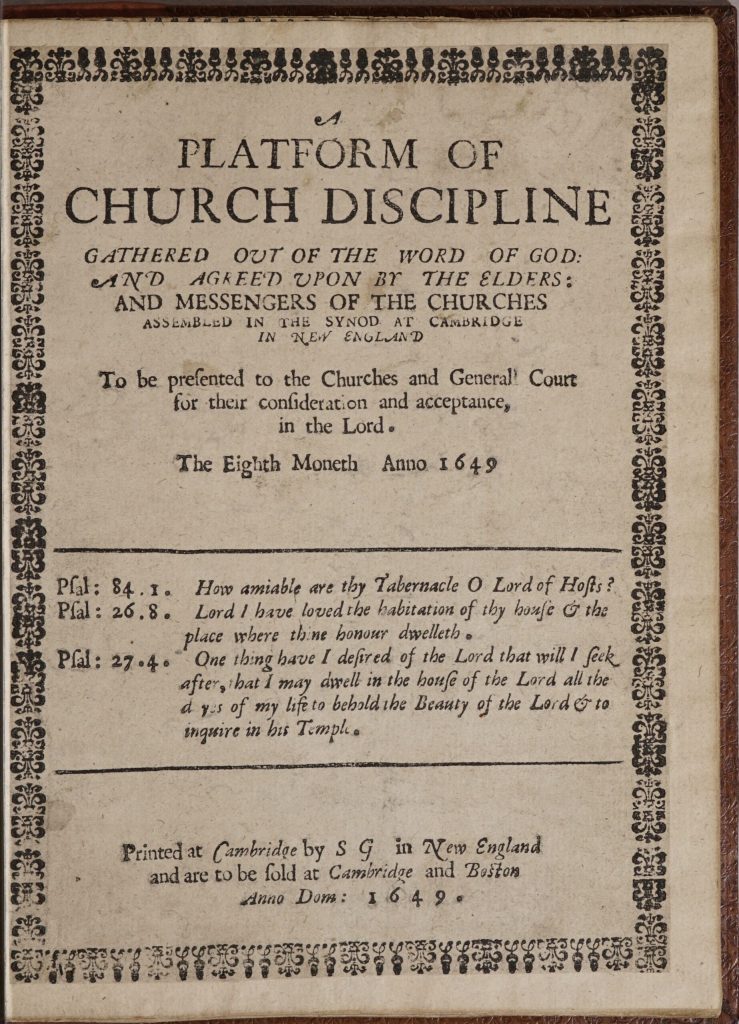
Church government is considered in a double respect, either in regard of the parts of government themselves, or necessary circumstances thereof. The parts of government are prescribed in the Word, because the Lord Jesus Christ, the king and lawgiver of his church, is no less faithful in the house of God than was Moses, who from the Lord delivered a form and pattern of government to the children of Israel in the Old Testament: and the Holy Scriptures are now also so perfect, as they are able to make the man of God perfect, and thoroughly furnished unto every good work; and therefore doubtless to the well-ordering of the house of God.[1]
In the last paragraph of the Platform, we remarked that all societies, natural and supernatural, require a polity. They all stand in need of a regulated government to bring order and actuate the ends of peace, decency, and order. In reference to the church, there is a “form and order that is to be observed in the church of Christ upon earth.”[2]
The question that naturally forces itself upon the inquirer into these things is whether there is such a form or order given in the times of the New Covenant to the church. It is evident that a detailed system of governance was given to the old covenant body, but is it true that the New Testament prescribes a “form and order” to the church?
Some have said no to this question. Men such as the famed Richard Hooker and Edward Stillingfleet, among others, have argued that there is no particular form of church government handed down in the New Testament for the church.[3] Clearly there is need for a government, but that government is determined by Christian prudence according to principles of natural law, the circumstances of time and place, and the general rules of the Word. One no doubt can see the reasoning behind such a position. There is no system of church government systematically arranged in the New Testament. No manual of church polity or book of forms and usages. Much that we see in the ecclesiastical arrangements and order of the church comes to us on account of the various exigencies of the church and thus ad hoc. One read can and has taken this as evidence that the Apostles in erecting the government of the church did so through the use of Christian prudence informed by the light of nature,[4] existing authority structures, and Old Covenant precedent. There is however another read.
The Platform takes a higher ground for the polity of the New Covenant church. Her polity is not left to her own wisdom, though sanctified. The “parts” of her government are prescribed in the Word of God, and she is called to be faithful to the Lord’s prescriptions for government. The Lord Jesus Christ is just as faithful as Moses, and as Moses gave a platform of polity to the Old Covenant saints, so the Lord Jesus gives a platform to his new covenant saints. Though the government of the church is not laid out systematically, there are discernable ordinances, institutions, and principles that are perpetually obligatory. A candid reader of Scripture can evidently see these perennial principles. As such, the Scriptures provide a rule not merely for the faith of the church, but the life of the church, which includes the church’s government.
That there is such a distinction between essentials (or parts) and circumstances ought to be evident to any rational human who engages with this question. The only person who wouldn’t admit it is a cartoonish and woodenly literal Biblicist who thinks that churches can only gather in households and that the church can only gather at the times of the day that the church gathered in the New Testament. In short, very few are that hardheaded.
There must be a distinction between the essence of an office or action, and its mutable adjuncts. It is clear that the preached gospel is an essential ordinance and institution of the New Covenant. That the Word of God is to be audibly preached to a hearing is the essential ordinance. It is nevertheless never abstracted from a particular circumstance with varied conditions. It is circumstantial how long the Word is to be preached, in what mode (studied or extempore), the content (which text and/or doctrine), and what order preaching bears to the other elements of worship, among other things. The latter are not prescribed by the Scriptures as the parts are. Just because it is circumstantial however, as we’ll see later, does not make it unimportant nor entirely without certain rules and guidelines.
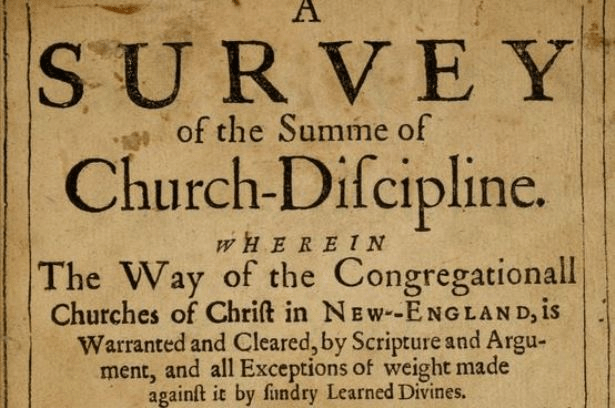
In proof that there is such an immutable rule concerning the essentials of church government and discipline left in the Word of God, we may consider Thomas Hooker’s reasons.
The first argument is that all parts of worship are by God alone appointed in the Word revealed. This proof may be stated thus;[5]
- P1: All parts of God’s worship are by God alone appointed in the Word revealed.
- P2: All offices and ordinances of discipline are parts of God’s worship.
- C: Therefore, all offices and ordinances are by God alone appointed in the Word revealed.
The minor premise he asserts is true and granted by all. Both the Larger and Shorter Catechisms of the Westminster Assembly refer “the receiving, observing and keeping pure and entire, all such religious worship and ordinances as God hath instituted in his Word; particularly… church government and discipline” to duties enjoined by the 2nd Commandment.[6] This is not merely the invention of New England Congregationalists, but is the common inheritance maintained by Presbyterians as well.
In further proof of the minor premise, Thomas Goodwin defends the notion that discipline is part of worship by these proofs: the means of worship are called the keys of the kingdom of heaven and these include excommunication, excommunication is parallel with prayer in Matt. 18:19, excommunication is done in the name and power of Christ, ruling as well as teaching and exhorting are referred back to reasonable worship in Rom. 12, and finally a fortiori from the consideration that contributions to uphold the ministry and giving to poor Christians are called sacrifices or services unto God in 2 Cor. 9:12.[7] Since the church with her discipline is a divine institution with the promised supernatural presence of Christ, it must be referred to the commandment that deals with positive and instituted worship.[8]
That the major premise is true “is evident from the nature of worship, which only proceeds from God’s will, and the appointment of it is his peculiar prerogative.”[9] What often passes under the name of the Regulative Principle of Worship is in purview here. God has the sovereign prerogative to dictate the mode in which he will be worshipped. Hooker marshals 1 Kings 12:32-33, Jer. 7:31, and Deut. 12:32 in proof, but there is a whole class of texts ordinarily brought into corroborate this principle.[10] God is the next and immediate object in worship, and He alone gives institutions their efficacy as means of communion with Him. Man cannot arrogate such an authority to himself. He has neither the wisdom nor the wherewithal. Such arrogated authority to institute new ordinances without the will of the Lord is the justly condemned sin of will-worship. Even the pagans worshipped their gods under the aspect that said worship had been determined and revealed by the gods.
In principle, it is eminently reasonable and well established from Sacred Scripture. The parts of worship, or essentials of worship, must be determined by God and revealed by Him in His Word. Naturally, thorny questions immediately arise concerning the distinction of essentials and circumstances and their content, how much human reason speaks into this, and the perennially noxious question of ceremonies. For now, however, we may rest in knowing that both premises are established, and thus the conclusion follows. The essentials of church discipline and government are by God alone appointed and to be found in the Word of God revealed.
[1] Heb. 3:5-6. Exod. 25:40. 2 Tim. 3:16.
[2] Cambridge Platform I.1
[3] See The Laws of Ecclesiastical Polity and Irenicum.
[4] Reason
[5] Hooker, Thomas, A Survey of the Summe of Church Discipline, p. 6.
[6] Larger Catechism 108; Shorter Catechism 50.
[7] Goodwin, Thomas, The Government of the Churches of Christ, p. 9.
[8] Distinguished from the 1st Commandment, which deals with natural worship.
[9] Hooker, A Survey, 6.
[10] Exod. 20:3-4, Lev. 10:1-3, 1 Sam. 10:8, 13:8-13, 2 Sam. 6:3-8, John 4:24, Matt. 15:1-9, Col. 2:23, etc.
 The Saybrook Platform