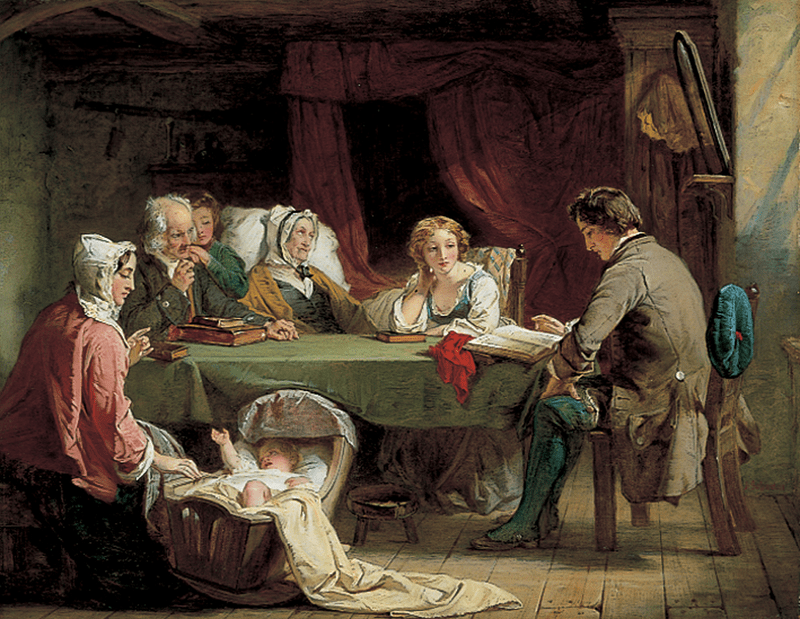
Sabbath Eve by Alexander Johnston
In beginning to consider the Sabbath, Thomas Shepard hearkens our attention to time. He states in his first thesis that it is “one of the most precious blessings which worthless man in this world enjoys.” Time is that which theologians consider just as measured duration, or the necessary concomitant of being a finite being that has an origin and succession on account of its mutability. As such, together with being, it is a gift of God that is of His disposing.
In the second thesis, Shepard notes that God is not only disposer of our time, but our very being. He is our origin and end.[1] This being the case, Shepard will go onto note that though all things are made for God as their last end in glorifying Him, man in distinction from “all inferior creatures” is made “nextly” for God. Man, having no better being between himself and God, has a certain proximity to God. He alone is possessed of reason whereby he may consciously and actively serve God. The lower creatures are nextly made for man and his use, but man himself for God. Thus stated, man has a unique “reflux” or return to God in distinction from the other creatures. Man is reasonable and not brutish. He lifts his eyes up to the heavens rather than down to the earth. His soul finds rest in God alone instead of the things of this world.
It is here that Shepard brings in the concept of omne contiguum aeterno spirituali est aeternum. All that is contiguous to the eternal spirit is eternal. What is next to and proximate to God is thus eternal. God is of himself eternal in his being. Man’s soul, made both nextly and lastly for God, is thus contiguous with the eternal God and so is eternal. Man’s body, made contiguous with his soul is eternal. Lower creatures, made nextly for man’s body, are not eternal as the human body is of itself mortal.
Man, made contiguous with God and next to him, is thus bound to return to God. Possessed of reason and made next to God, we are qualified for an active service of God that is both reasonable and conscious. This operates on the cosmic level, as at the end of our lives we must return to God from whom we came. When we die we must enter our eternal rest and beatific vision. In imitation of this cosmic return and rest, God has by his wisdom so ordered an imitation and reminder of this in the natural cycle of the week. He has so appointed that one day-in-seven man will return to God in a special sense as a foretaste of his eternal rest in God. This is the Sabbath. The day which enjoins not merely a physical rest, but a religious rest.
Further, man was not made for the Sabbath in regard of its outward rest, but he was made for the Sabbath insofar as God is in it as our rest to which we are to return. Now, Shepard notes that resting in God eternally is not a ceremonial duty, but rather a moral duty and a privilege enjoyed by man. If this return to God and closing with Him is moral, so too is the command which calls us to rest in and return to God every seventh day. To state it as a syllogism;
- Man’s rest in God eternally and at death is a moral duty.
- Man’s commanded rest every seventh day is like for substance with man’s rest eternally in God.
- Therefore, man’s commanded rest every seventh day is a moral duty.
The major premise is evident. Man was made and fitted for the end of glorifying God and enjoying him forever.[2] This must not merely be a ceremonial duty, but a moral duty all men everywhere are obligated to.
The minor premise is evident in that things same for substance or essence possess like qualities. If man’s eternal rest be moral, then man’s rest in God every seventh day must be so too.
Man was made to rest in God, and the Sabbath is an appointed medium for man’s rest in God in this life. We are obligated to return and rest in God every seventh day. It is a rich and rewarding blessing for a noble creature such as man to make such returns to his even nobler benefactor. God has richly diffused both being and time to his creatures. Man himself He has qualified both with a reasonable soul and adorning graces. He has furnished us for his service, both nextly and lastly. May we return to God every seventh day in foreshadow of that great eternal rest when our race is run.
[1] Rom. 11:36.
[2] Ps. 73:25-28. 1 Cor. 10:31.
 The Saybrook Platform