
The CCCC is considering a name-change to Centerpoint: Biblical Congregational Conference. Per the name change’s votaries, the name is meant to emphasize the center of the denomination, or that about which it turns. In illustrating the significance of the name change, the analogy of a well is employed.[1] A well serves as an oasis, a centripetal point about which weary travelers and societies congregate and share in life. As a well serves as a focal point for a society, so the name “Centerpoint” is meant to convey what our denomination is centered on. When asked, the explication typically conveys the sense that Jesus, the Gospel, and/or the Holy Scriptures are the conjoined center about which our denomination centers on, and the name is intended to convey that to inquirers. This analogy of a well is opposed to a fence analogy, wherein the fence circumscribes. A living center versus a stifling boundary. The “Conservative” moniker is circumscriptive like the fence as opposed to the well. It defines us rather by what we are not, than what we are. By external contours rather than living force.
It should be noted at the outset that it is an appreciable thing that the contemplated name change wants to emphasize what the denomination is. As we noted earlier, positive definitions are better than negative ones. Further, it is good that the denomination wants to center on truths which are worthy to center on, as allegiance to the Lord Jesus, faithfulness to the Sacred Scriptures, and hearty belief in the Gospel. Lastly, it is commendable that the proposed change retains the term “Congregational.” In an age that rejects denominational modifiers, it is not an insignificant thing to continue to identify with our venerable fathers in the faith, who traversed the Atlantic, nourished piety in our country, and propagated the institutions and ordinances of the gospel in a barren land.
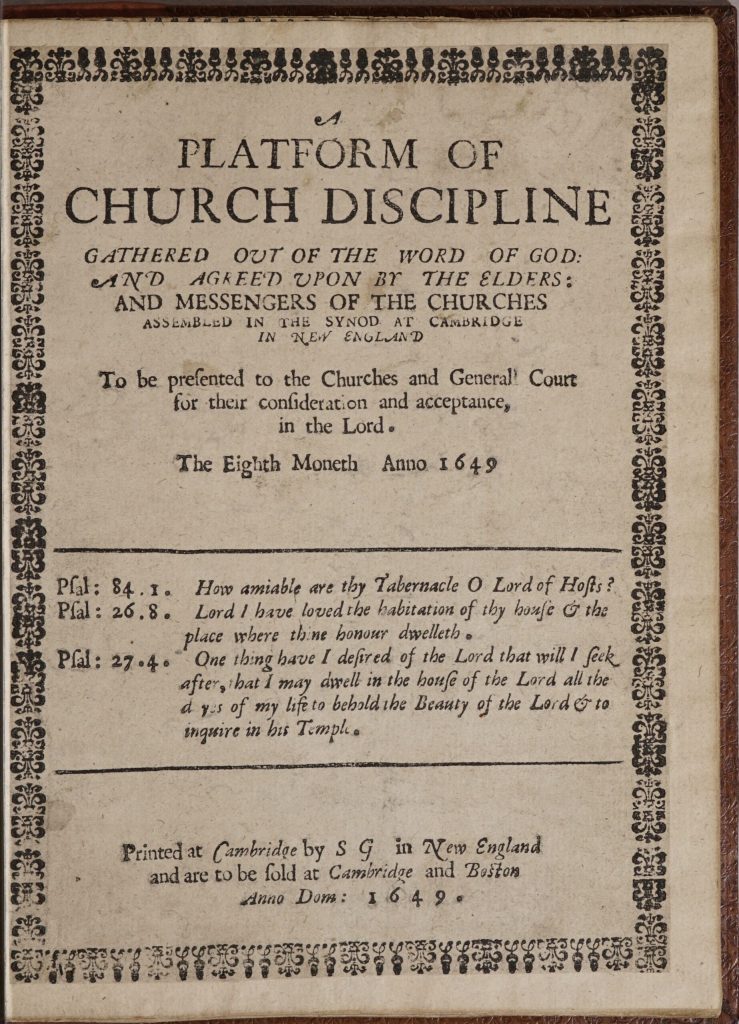
If there are commendable aspects of the name change, there are yet concerning aspects as well. I will limit myself to two principal concerns. The first is what I’ll call the commodification or marketization of the church. Sometimes a brand is found to be losing market shares and sales to competitors. It isn’t grasping the same audience, and it seems to not draw the youth anymore. In response, a rebranding team is formed in a last ditch effort to save the product and revive its sales and relevance. If it works for Sierra Mist and Twitter, than why not the church? The Conservative Congregational Christian Conference is not alluring enough to prospective worshippers and is failing to grasp the hearts and imaginations of the youth, therefore if we change the name to Centerpoint, we will go some way in solving our woes. I will avoid discussing the banality of the name “Centerpoint” and the fact that the change screams insuperable last ditch effort at attaining relevance in order register the concern that the name change tends to reduce the idea of the church and its communion into just another market product and consumable. Rather than being the divine institution founded by Christ for the salvation of man and glory of God, it tends to reduce the church into a merely human and temporal commodity. The process of rebranding a communion of churches itself does not treat the church and its communion like “a company of saints by calling, united into one body by a holy covenant, for the public worship of God, and the mutual edification of one another, in the fellowship of the Lord Jesus.” The church is the “pillar and ground of the truth,”[2] not a bag of Doritos.
The second concern with the name change is that of direction and drift. It is fundamental to the idea of a rebrand that there will be a change of appeal, direction, and goal. Will the CCCC retain its emphasis upon fundamental doctrines such as the Trinity, Incarnation, Atonement, Judgment, Resurrection, and Inspiration of the Holy Scriptures? Will the CCCC remain stalwart in denouncing homosexuality, abortion, and pornography? You will have to excuse many in the CCCC who are concerned that the denomination is moving in a more latitudinarian direction.[3] The “Conservative” in CCCC was communicating a concern to retain orthodox theology and praxis, and so the desire to jettison the name will naturally induce suspicion. It’s a great platitude to say we want to center on Jesus, the Gospel, and the Scriptures. The question is whose Jesus, what Gospel, and which interpretation of the Scriptures?
Is it the case that this name change is symptomatic of an increasing allowance of deviant errors? Now I have no doubt that the majority of those interested in the name change are themselves orthodox on these points, but it cannot be entirely discounted that there are those interested in a name change who would love to see liberalization of the CCCC in regard to theology and ethics. Let us learn the lesson that the PCUSA taught us in the 1920’s and 1930’s when it was the lackadaisical moderates, themselves orthodox, who opened the floodgate to apostasy and lasciviousness. The CCCC could use a bit more of the spirit of Machen in seeking to preserve sound Christian teaching and practice. Better yet, let us cultivate the virtues and spirit of our ancestors, the Puritans, in seeking to promote and propagate sound Christian orthodoxy and historic Christian ethics. In this vein, retaining the present denominational name, the Conservative Congregational Christian Conference, communicates to the world our connection with our spiritual forbears, our denominational and creedal life, and most importantly our foundation upon the Sacred Scriptures. Like we said earlier, the present name is not set in marble. It can be changed. But then, let the name change communicate, with more terseness,simplicity, and biblical fidelity, our specific denominational commitments and geographic location, and not amorphous platitudes. Let us not trade a name, and get more than what we bargained for. After all, there is a lot more in a name than merely consonants and vowels, but a significant thing, either good or evil.
[1] See https://www.centerpointconference.org/.
[2] Cambridge Platform II.6
[3] I say more as there is already a large latitude of belief and practice in the denomination. The allowance of women’s ordination, Calvinism and Arminianism, Cessationism and Continuationism all communicate this point.
 The Saybrook Platform