

As Capt. Jack Aubrey noted in the film Master and Commander, “there are hierarchies in nature.” Not only so, but “men must be governed.” This wise and sagacious man, though but a movie character, recognized a principle so built into the natural fabric of reality that us moderns who have an inability to discern it and faithfully proclaim it are put to shame.
Man is a sociable creature as the Philosopher has stated. His capacity for speech proves as much. He must unite in societies with his fellow man in order to realize his true nature about a common good. His end or purpose supposes that he unite with fellow rational creatures. This principle is universal in its claims, and exacts its toll in the civil, domestic, and ecclesiastical spheres. Samuel Willard testified to this principle when he proclaimed that “The law of nature also requires this, that in all societies there should be order, nor can they consist without it, but all things will be brought to confusion.” Where any society lacks a government, there is to be confusion. Disorder rather than order.
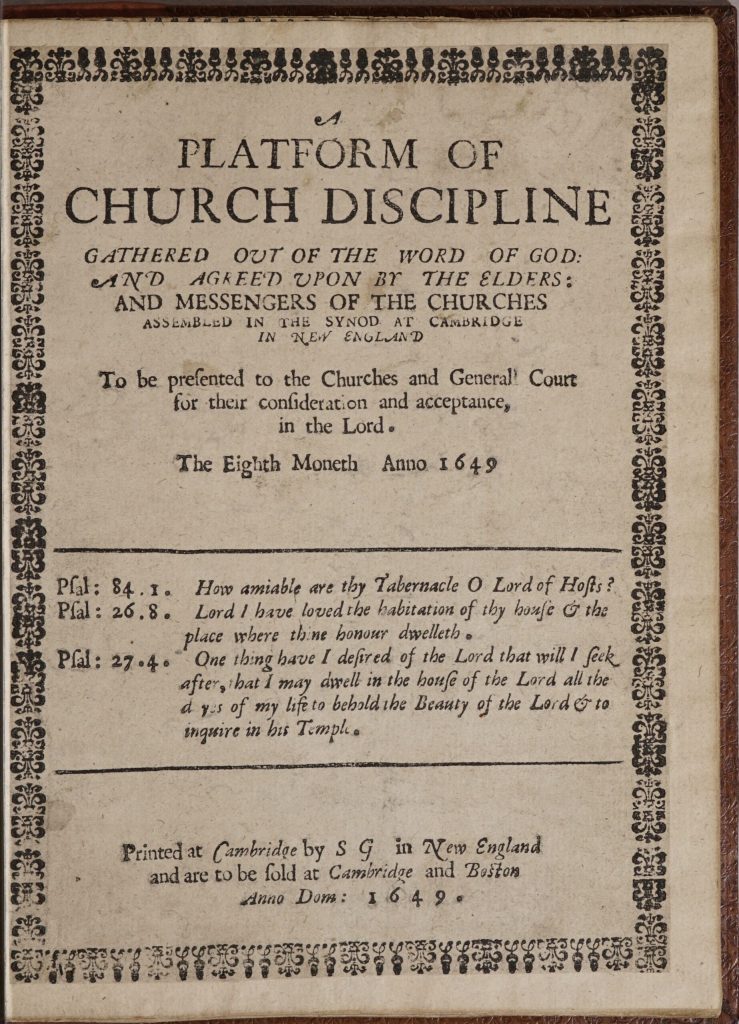
The Cambridge Platform proclaims the truth of this principle in relation to the church. The Platform states that,
Ecclesiastical polity, or church government or discipline, is nothing elder but that form and order that is to be observed in the church of Christ upon earth, both for the constitution of it, and all the administration that therein are to be performed.[1]
The Platform employs the term “polity” and clarifies it with equivalent terms such as church government or discipline. John Owen, observing the common acceptation of polity, would note that it is taken for “the rule of the church.” He would clarify that it involves an authority or power, a skill and wisdom of acting that power to proper ends, and the actual exercise of this power according to that wisdom. Further it involves the idea of government as application of power to its proper objects.[2] It involves the idea of an ordered society with rulers and ruled, vested power, and skill of applying that power to proper ends and on the proper objects.
Should we consider the church merely in her common nature as a society, and a religious society at that, we would see the necessity of a polity or government. As a body of men united for a common purpose, the church would require ordered relations and a government to secure the perennial ends of peace, unity, and edification. As the English bishop Edward Stillingfleet would note, ‘“‘the reason of church government is naturally of divine right,’ that is, that the reason of church government is immutable and holds in all times and places, which is the preservation of the peace and unity of the church.” As the church in all ages demands peace and unity, there must be a government in the churches to secure these immutable ends or final causes of the church. It is “unalterable by divine right.”[3] Lest there be anarchy in the church, and inefficiency in the church to secure her ends she must have polity or government.
That the Bible assumes this in the case of the New Covenant church is evident from many and sundry texts. Paul[4] could tell the churches to “obey them that have the rule over you, and submit yourselves: for they watch for your souls, as they that must give account.” Not only so, but Christ who has ascended on high has given to the churches “some, apostles; and some, prophets; and some, evangelists; and some, pastors and teachers;For the perfecting of the saints, for the work of the ministry, for the edifying of the body of Christ.”[5] The New Testament both supposes that there are rulers in the church to be submitted to, and explicitly declares that Christ has given such officers to the churches. Not only so, but these churches are given the “keys of the kingdom of heaven.”[6] They are given rules for dealing with disciplinary issues in the churches, and gospel institutions to be observed.[7]
Should this not satisfy the reader, the pastoral epistles are rich and detailed in explicit acknowledgment of a polity and government to be observed in the churches. Clearly there is a constitution in the churches, and an administration. The church is not to be like a disordered array of Barbarian hordes, but a compact Roman legion with a fixed order, officers, and administration. Not like blazing comets out of orbit, but like the well-regulated Solar System which observes its revolutions.
As we’ll explore later, the church is vested as a body with power from the Lord Jesus Christ to secure the ends of her appointment. In order to realize these ends, there must be a formal government in the church. The lack thereof is deleterious. Disorder breeds confusion. The proverb rings true, that some government is better than no government.
The Cambridge Platform declares this necessity of polity or government in the church, noting that it is the “form and order that is to be observed in the church of Christ upon earth.” It is obligatory; to be perpetually observed until the church sees the “Son of man coming in the clouds of heaven with power and great glory.”[8] It is to be the “constitution” or fundamental law of the church, and all her administrations are to be regulated by it.
Let modern Congregational churches ever hold to the necessity of government in the churches. Should they want to be faithful to the commission of Christ and their obligations to their divine Redeemer, a government is immeasurably calculated to be a benefit to the churches. The church with a fixed polity and government is our Jerusalem.
Jerusalem is builded as a city that is compact together:Whither the tribes go up, the tribes of the Lord, unto the testimony of Israel, to give thanks unto the name of the Lord. For there are set thrones of judgment, the thrones of the house of David.[9]
The church that observes due government and polity is as a compact city, knit together in bonds of Christian charity and order. It is the rendezvous of the people of God come together to worship the Lord and glorify their maker in observing his ordinances. There are thrones for the due government of the church therein, where justice and judgment are enjoyed.
This should drive us to our knees with open arms to implore the Almighty, and with David to “pray for the peace of Jerusalem.”[10] Pray that God would so constitute our churches to be faithful in government and polity, and to give us faithful, wise, and good rulers who seek the everlasting welfare of Zion.
[1] Cambridge Platform, Chapter I, I.
[2] Owen, John, The True Nature of a Gospel Church, 31.
[3] Stillingfleet, Edward, Irenicum, 41.
[4] No apologies.
[5] Eph. 4:11-12.
[6] Matt. 16:19.
[7] Matt. 18:15-20; 28:18-20.
[8] Matt. 24:30.
[9] Ps. 122:3-5.
[10] Ps. 122:6.

