Theology of Synods in Congregationalism
Adam Shanahan
- Introduction
In the year 1858, Rev. William GT Shedd, speaking before the Congregational Library Association, put the question to the Congregationalism of his day; “Are we not then summoned… to consider the need of more centripetal force in Congregationalism, in order to its greater efficiency as an ecclesiastical denomination?” He would go on to say that “the denomination needs to control its tendencies to vagueness, and diffusion, and to render its distinguishing characteristics more intense by concentration.”[1] Shedd would go on to locate this centripetal force or concentration within a common doctrinal faith, or as he says a symbolical feeling. This was to be the answer to the problems associated with the diffusive quality of Congregationalism. If the hearts and minds of the ministers and lay people were to be knit together, the center must be found in a profession of a common faith, as found for the Congregational church in the Savoy Declaration of Faith and Order as adopted by the New England churches.
Next to a common profession of truth in doctrine, there must be other centers of centripetal force for the life of a denomination. For the Roman Catholic Church, the clearest expression is the Papacy and the infallible magisterium. For Anglicans and Episcopalians, it is either communion with the Archbishop of Canterbury or a common liturgy in the Book of Common Prayer. For Presbyterians, it is a common profession of the Westminster Confession of Faith and subjection to the ascending church courts from Presbytery to General Assembly. Is the Congregational church capable of such an ecclesial center? Can Congregational churches which so stress their independence and freedom from domineering admit of an external means of centripetal gravitation?
Shedd’s judgment is not unfounded that a common profession of faith must be absolutely essential and have primacy if the Congregational churches are to be united in a common work with a commanding efficiency in making Christ known and propagating her influence. But the question that comes before our consideration today is whether there may not be other centers about which Congregational communion can gravitate. Shedd notes that though “the temple, nor the cathedral, nor any of the mechanism of an ecclesiastical denomination, be regard of equal importance with the animating principle of piety in the hearts of church members. And yet neither science nor religion, neither the state nor the church, can wholly neglect these outward instruments of organization and union, without somewhat scattering their elements of power, and wasting their force.”[2] As he more tersely puts it, “a centripetal point, even though it relate to externals, is not to be despised.”[3] Such may be a formal associational relationship, and synodal relationship among Congregational churches. Next to a common profession of doctrine, the surest measure to secure a unity of action and feeling among Congregational churches is proper church association, with the peak being church synods and councils.
As such, this paper’s aim is to incite, or perhaps initiate, a synodical feeling in addition to the necessary symbolical feeling. This is the more necessary given the present state of Congregationalism. Rampant individualism and the slow poison of time have each performed their number upon Congregationalism. Proper connectional feeling and the wholesome elixir of ressourcement of historic Congregational theory and practice are the solution. Most people’s exposure to congregational church polity or government come in the form of the worst excesses of pure democracy, the tyranny of a one-man show, and/or little connectional association with other churches. It is here that the historic Congregational theology of synods, church councils, associations, and consociations can serve as a corrective to the modern practice of Congregationalism. In order to that, we must first know the grounds, causes, and nature of synods as expressed in the historical symbols and platforms of Congregationalism, as illumined in historical practice and the Congregational divines of the age. This is pertinent to our era in which the average churchgoer or parishioner has little experience with or knowledge of synods and councils. The paper will terminate with several concluding inferences from what is seen of the theology of Congregationalism and her synods.
- Platforms of Congregational Polity
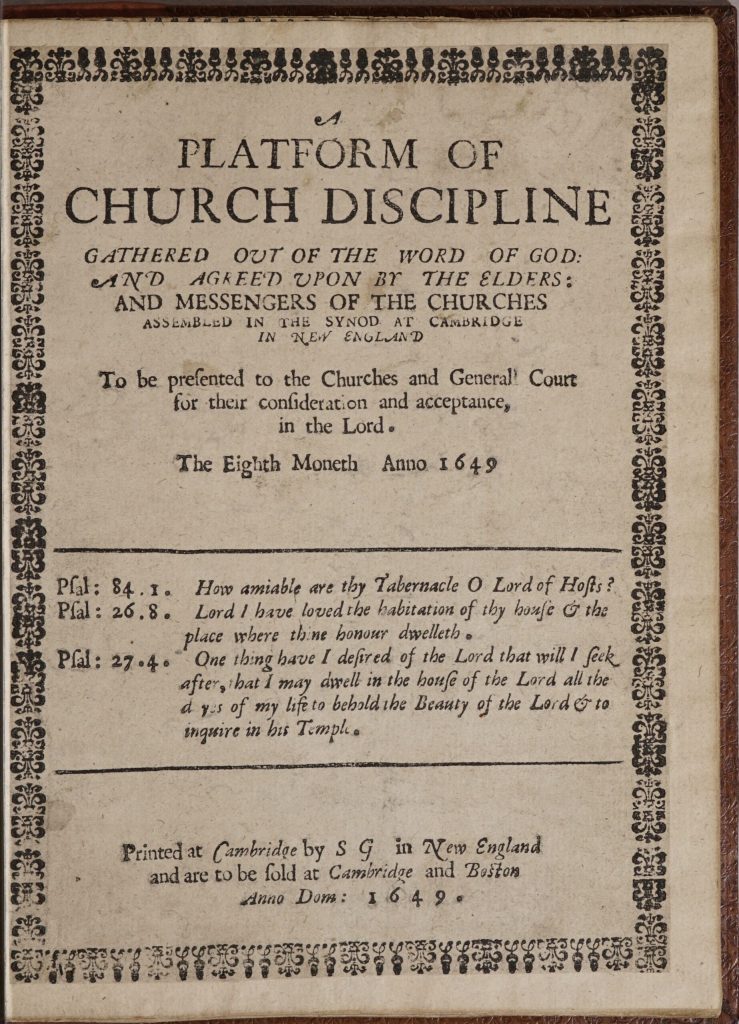
- The Cambridge Platform
When discussing Congregationalism, it is only fitting to begin with the Cambridge Platform, which has acted as the fundamental constitution of Congregational church polity. Though there were earlier expressions of congregational church polity in the British Isles and the continent, it is only in New England where a sympathetic magistrate and ministry allowed for the formalized expression of Congregational church polity.
Having already addressed the origin, nature, and offices of the church, the Platform picks up the discussion concerning Synods in Chapter 16. As a necessary, yet abridged prolegomena, we must note the general features of Congregational polity more largely. The Lord Jesus Christ, king and head of the church has called out from among the nations a people to show forth his praise. This people may be contemplated mystically as the body of those elected in Christ from all eternity and effectually called in time and united to Christ unto all eternity, and as distinct political societies of men visibly professing faith in Jesus and living as visible saints uniting as a body in covenant. To these distinct and particular churches, Christ has given power to execute all those institutions, ordinances, and worship requisite for such societies to publicly glorify God in this world. This power resides variously in the church. In the laity or brethren, it is a power of privilege, while in the elders of the congregation it is a power of rule and church government whereby they feed and rule the church of God.
Prior to Chapter 16 on Synods, the logical antecedent and prerequisite of “Communion of churches one with another” is enumerated. Distinct and local churches, though subject to all the power required to the essence and existence of true churches of Christ, ought to maintain church communion with one another “because they are all united unto Christ, not only as a mystical, but as a political head.”[4] This communion is to come to expression in mutual care, consultation, admonition, participation, recommendation, and relief. The communion or fellowship of churches entertained is not merely a whispy and vapid informal fellowship or glorified Christian conference, but a substantial and formal association with a degree of power and authority for supernatural ends. Enter the Platform’s chapter upon Synods.
The Platform proclaims that rightly ordered synods or councils following the model of the Jerusalem Synod of Acts 15, are “ordinances of Christ.” Synods are not merely a prudential good taught by the maxims and conclusions of the light of nature or faithful reason (though they are certainly not less then that), but that they are divine law legislated and prescribed by the Lord and Head of the church. As John Owen would later say, these synods “hath the force of a divine institution, as being given by them under the infallible conduct of the Holy Ghost,”[5] or as he elsewhere says, “an institution of Jesus Christ, not in an express command, but in the nature of the thing itself, fortified with apostolic example.”[6]
In quick succession however, these synods are noted to not be absolutely essential to the being of the church, though they are nonetheless many times necessary to the wellbeing of the church. In speaking to this point, the New England theologian John Norton quotes the theologian Festus Hommius approvingly as stating that “councils are… to a degree necessary. The church could not be cut off from this salutary means of relief without notable injury to truth, piety, and Christian concord.”[7] Not quite an absolute necessity, but the nearest thing thereto. John Norton lists sundry reasons for this degree of necessity attending synods, including the natural right of appeal from lower to higher courts, the example of the Jewish and Apostolic churches, the preeminence of knowledge of a council relative to any particular church, the fostering of the communion of churches, and finally from the nature of church issues which affect all churches directly or indirectly.[8]
The second article analyzes these synods through the prism of Aristotelian causality, noting that the next efficient cause (under Christ) is the power of the churches sending elders and other messengers. The material cause are these same ministers and delegates meeting in the name of Christ. The formal cause is debating and determining matters of religion and publishing the same. Lastly, the final cause is negatively conviction of error and positively the preservation of truth and peace in the churches. Taking this prism of causality, we may define a synod as a meeting of messengers delegated by the churches meeting in the name of Christ to determine matters of faith and practice to the end of truth and peace in the churches.
The platform further affords a right to the civil magistrate to call a synod, but yet with careful language it is remarked that the constituting of a synod is a church act. This being the case, if the civil magistrate be opposed to the church, the church retains the right to “transact” such synods.[9] It is essentially a churchly and ecclesial act, not essentially subordinate to the civil power.
Returning to a more thorough consideration of the formal cause of a synod, the Cambridge Platform affords to synods the power of determining matters of faith, cases of conscience, directions for government and worship, bearing witness to maladministration and corruption in particular churches, together with giving direction for reformation from such corruption. John Cotton in speaking to the power of such synods maintains that they may command and enjoin things to be done and believed, to withdraw communion from a contumacious church or presbytery, and decree and publish such ordinances as may be conducive to reformation.[10] A qualification that Cotton notes is that synods have not the power to enjoin things in their own nature and use indifferent upon the churches, thus prescribing the power of synods and setting them within certain limits.[11] The synod also cannot enact church censures in a way of discipline, properly acts of church authority or jurisdiction. This qualification is particularly that which would separate the Congregational and Presbyterian divines, as the latter ascribe proper church authority and jurisdiction to the ascending courts and synods of the church.
John Owen in clarifying the formal power of a synod concludes that a “synod convened in the name of Christ, by the voluntary consent of several churches concerned in mutual communion, may declare and determine of the mind of the Holy Ghost in the Scripture, and decree the observation of things true and necessary, because revealed and appointed in the Scripture; which are to be received, owned, and observed on the evidence of the mind of the Holy Ghost in them, and on the ministerial authority of the synod itself.”[12] It should be noted that for Owen, as well as the Platform and the generality of Congregational divines, the declaration and determination of the mind of the Holy Ghost is an “authoritative teaching and declaration” of the doctrines of revelation. In regards of the second component concerning decreeing the observation of things true and necessary, Owen qualifies this as concerning things already and antecedently obligatory, for which he uses the example of the decrees of the Synod of Jerusalem; no meat offered to idols, abstention from blood and things strangled, and the disallowance of fornication. These already obliged the church by force of divine law in conjunction with tenderness toward weak and ill informed consciences.
The Platform having considered its formal cause or work, now proclaims the obligation and authority of its asseverations. Synod directions and determinations have a twofold obligation. The principal obligation arises from their agreement and conformity with the word of God.[13] Thus far, this is the same kind of obligation that would arise from any fellow Christian exhorting and admonishing another. As the exhortation agrees with the Word, it binds the conscience of the companion to receive what is said. In addition to this, however, there is a secondary obligation arising from the acts of a synod. Synods are an ordinance of Christ and are possessed of a derived power, which further obligates the conscience to submit with reverence and submission to their decrees and determinations. They are to be believed and obeyed, not only as agreeing with Scripture, but as a legitimate institution of Jesus Christ vested with authority.
It is in this sense that Cotton affirms that synods and their decrees bind not only materially or for their agreement with the Word, but also formally from the authority and power to which a synod is subject.[14] It is this formal binding nature of the decrees of a synod that would give ground for what Hooker, Cotton, and Norton in describing the true determinations of a synod would say is decisive and conclusive. Thomas Hooker states that “They have dogmaticum decisivum judicium, i.e. they may dogmatise and set down their judgements definitively, and by way of determination.”[15] They terminatively decide the matters that come under their consideration.
They cannot judicially adjudicate issues in the churches, nor do they have ecclesiastical jurisdiction for handling cases within the churches. As such, they cannot lay a legal obligation upon the churches upon pain of censure or excommunication, but this does not forbid the synod and council from laying a “direct obligation” upon the churches in the words of Norton. Though a certain kind of power and authority is resident within a synod, the judicial power of church censure and excommunication resides within the local church to be exercised by the elders. A case of censure or excommunication within a local church may be appealed to a synod for their judgment and determinative conclusion, but this said decision is not judicially binding in of itself, though it has some degree of authority with it.[16]
The Platform’s treatment of synods is terminated by consideration of the matter of synods. Since it is near insuperable impossibility that all the churches and their members can meet in one place for such a synod, the principle of representation and delegation is maintained. As to who these delegates may be, both elders and lay members are to constitute these councils. The former because they are most likely to know the state of the churches and best able to advise for the good of the churches, and the latter because the concern of the churches is not restricted to the clergy and ministry.. Owen in fact recommends as sound policy the principle that “elders or officers… ought to be the principal” delegates at synods.[17] As the Synod of Jerusalem shows though, lay members may also be delegates, with the qualifications that they be endowed with gifts and sent by the churches.[18]
- Saybrook Platform
In moving to the 18th Century, the churches of New England had long been established. For 70 years they had sought the pure faith and order of the gospel. A colonial backwater, she had nonetheless cast off her tyrannical governor Edmund Andros, secured a new charter for her government, and maintained largely the interests of true evangelical religion within the New World. It was not a time of unmitigated optimism however, as any cursory glance at the famous Jeremiads of the New England clergy would show. New England was seemingly losing her first love. A worldly spirit was at work and threatened the churches therein. This threat gave rise to, among other things, the Massachusetts Proposals of 1705 and the Saybrook Platform of Connecticut.
Many within New England viewed the lack of implementation of the principles of the Cambridge Platform with lament. One of the means by which an orthodox faith and sound practice of discipline and communion among the churches was to strengthen the ecclesiastical bonds of the churches of the respective New England colonies. Of course, this had already been exercised in a variety of modes. These include the occasional colony wide synods such as those in 1662 and 1679. Additionally, ministerial conventions where the ministers met at the time of the colony general election to consider the state of religion and propose certain pieces of advice. Lastly through ministerial associations where local ministers met together to keep watch over one another, license preachers within their bounds, and mutually promote evangelical religion. Nonetheless there was common recognition especially among the ministers that a more regular union and communion of churches was necessary to the welfare and wellbeing of the churches.
The Proposals of 1705 in Massachusetts and the Saybrook Platform in Connecticut were two answers to these problems. The Proposals of 1705 were the recommendations of an Association of the Ministers around Boston for the promotion of formal synods, councils and associations between the churches within the colony of Massachusetts, while the Saybrook Platform was a corresponding work within the Colony of Connecticut. The latter would gain the sanction of civil law and be implemented in the churches of Connecticut, while the former would be relegated to that unenviable category of pious advice unceremoniously ignored. Both of these promote stated ministerial associations and church consociations.
The ministerial association is to be made up of elders or pastors. That which is their formal work is to mutually consult the duties of their office and matters of common concernment to the churches. Both documents would specify this formal work and include many and sundry functions. They would function as deliberative bodies that contemplated questions and cases of importance, raised either by themselves or fetched from others. They would also advise in any matters in the churches likely to produce “embroilments” or scandals. Furthermore, they are tasked with watchfulness over each other’s life and doctrine, such that if a legitimate accusation against one of the ministers be lodged, they are to call a council to proceed against them. Further, they would meet to resolve questions and disputes given to their consideration, and be consulted by churches in lack of a minister with their recommendations for the office.
They would not merely be deliberative bodies however, but also licensing or credentialing associations, such that candidates of the ministry would undergo a ministerial fitness trial from the association, and any occasional preachers within the churches had to have a testimonial from the local association. Likewise, they were to be consulted by the churches for recommendation of fit and qualified pastors and for stated supply of destitute churches.[19]
They would also function as a referral body that would give direction about the convening of councils though necessary for the well-being of the churches. The Massachusetts Proposals in particular envisions these associations “maintaining a due correspondence” with one another that the state of religion may be better known and promoted. This correspondence includes the “necessary” provision that all the associations of the country meet together once a year, in the person of delegates from the local associations.[20]
These ministerial associations already had something of a history in the colonies of New England. From the earliest times of the colonies, there was a “General Convention of Ministers” which occurred at the time of the meeting of the General Court election day in May annually.[21] This General Convention of Ministers would, in the words of Cotton Mather, meet and “propose matters of public importance, referring to the interest of religion in the churches.”[22] This convention however did not arrogate to itself a decisive power over the churches, but ever remained an advisory body. Though just an advisory body, that didn’t preclude Mather from noting that “Excellent things have been here concerted and concluded, for, The propagation of Religion; and collections produced for that purpose in all the churches.”[23]
Besides this General Convention, there were district associations of ministers, which were smaller meetings of ministers of a more localized nature, as within the vicinity of a town or county. Cotton Mather once again supplies us with the purpose of these local association, namely, resolving their work to the heads of debate of matters of import, to consider proposed cases from churches and individuals, to answer letters, and to discourse about any question.[24] As an illustration of such questions dealt with and answered by these ministerial associations, we have the example of the Cambridge Association which dealt with such questions as the obligation of ministers to visit the sick in times of epidemics, whether a man may marry his wife’s sister, the power of synods over particular churches, the lawfulness of significant ceremonies in worship, instrumental music in the public worship of God among others.[25]
Not merely ministerial associations are envisioned, but church consociations are entertained. They are constituted by the ministers and other delegates of the churches within a geographic parcel. A question that may arise is whether there is a distinction to be made between ministers and delegates in the constitution of these synods. Do ministers convene here by right of and in consideration of their office, whereas delegates are merely men appointed as representatives by the churches? Are delegates a sort of inferior member of synods under this scheme? Increase Mather, giving an answer to this question, notes that “it is not their pastoral office, but the churches delegation, which gives them a right to be there.”[26] (Mather, Disquisition, p. 19) Ministers and pastors do not have a formal and proper authority within synods with which to constrain the churches. Rather, all appear under the formality and aspect of being delegates of the churches. Pastors and ministers being the educated and learned men that they are, it is natural they should be a preeminent portion of synods and their decisions. Mather would go on to say that “it is rational, that it should be so, others being not ordinarily capable to judge in abstruse controversy. There is a divine authority belonging to pastors.”[27] (Mather, Disq. P. 27) As the word parson would convey, the pastor is “the person”, and thus eminently entitled to participation in synods by virtue of giftings and office, though their formal power within the synod is of the same consideration as other delegates. [28]
Consociations are to meet to determine matters of common concernment to the churches, or in the common technical language, to conclusively and decisively determine matters. To render final judgment. These would include both doctrinal and practical matters, similarly as had been the practice among New England synods and the ministerial associations. The Saybrook Platform, clarifying this decisive judgment of a synod, calls it a “final issue, and all parties therein concerned shall sit down and be determined thereby.”[29] The synod may see that their determination or sentence shall be “executed and attended” in ways proportionate to their power. The Massachussetts Proposals further add the provision that decisions of one consociation may be appealed to another consociation of more members and more churches. This is the same kind of judgment afforded to synods by both the Cambridge Platform and the earlier Congregational divines, and all this while they continue to deny a proper judicial authority to the acts of a synod.[30]
This action, being the determination of the delegated churches, ought to be reverenced and observed by the churches. In cases of scandalous conduct, or “gross disorders as plainly hurt the common interest of Christianity, and are not meer tolerable differences in opinion, but are plain sins against the command and kingdom of our Lord Jesus Christ.”[31]contumaciously maintained, the churches are thereby to observe the determination of a synod in observing non-communion with the scandalous party whether an individual or a church. This sentence is clearly distinguished from a proper censure or act of excommunication, once again precluding proper ecclesiastical jurisdiction from being resident in the synod or consociation. Exactly how does this act of non-communion differ from an act of excommunication properly considered? Jeremiah Burroughs notes that this act declaring that “these erring people or churches are not to be received into fellowship with any of the churches of Christ, nor to have communio with one another in the ordinances of Christ.” This judgment is further performed “in the name of Christ” and flows from the judgment of “a solemn ordinance of Christ.”[32] Burroughs will even go on to say that this act has the functional or material result of putting out a person or church from the kingdom of Christ and under the power of Satan, which is the desire of Presbyterians in maintaining a proper judicial act of excommunication. Nonetheless, the formality of the act of non-communion is not a judicial binding of one’s sins to their conscience, but a principle of the light of nature that any voluntary society or associations of bodies has the right judging who is fit for participation.[33]
With these twin proposals, a thorough connectional and synodical relation would be constituted between the churches in order to a better discipline within and communion among the churches.
- Conclusion
The Cambridge Platform has served as the fundamental law of Congregational polity. Therein is entertained not a barefaced independency, but a strong ideal of the communion of churches especially as manifested in the role of synods and church councils. The Massachusetts Proposals and the Saybrook Platform are both prudential applications of those principles to the time, place, and circumstances of the Congregational churches in the Massachusetts and Connecticut colonies.
The first inference or conclusion we should reach is an instructive, both for those within and without the Congregational fold, but especially for those within the larger Reformed and Presbyterian world. Assuming the Cambridge, Massachusetts Proposals, and Saybrook, we may see the reason why someone like Increase Mather would promote the Heads of Agreement among Congregational and Presbyterian churches in England. If Congregationalism be practiced according to these historic symbols, there is only a hair’s breadth of disagreement between Congregationalism and Presbyterianism.[34] This is not to downplay genuine areas of disagreement, but to focus upon the staggering approximation to one another in matters of church communion, while also clarifying the genuine areas of disagreement such as the judicial power of extra ecclesial gatherings of the churches and the legitimacy of lay involvement in such synods. As the 19th century Scottish Presbyterian James Bannerman proclaimed, “It would be well if the position of modern Independents on the question of Church polity were no further removed from our own than that which is marked by the illustrious name of Owen”[35] for they agree in the leading principles of Presbyterianism. We may well insert the historic Congregational symbols and the conclusion would naturally follow.
Another inference is the centripetal role of synods and councils within Congregationalism. They exist for the benefit of the churches and are a means for their united energy and efficiency. If the Congregational church were to tap into their potential, much light would be diffused among the churches of Christ in contemplating matters of theology and their application to a 21st Century American context. Not only so, but the warm bonds of brotherly affection would be nourished and maintained by the exercise of such a provision. Matters of common concern to the churches of Christ could be decisively determined, in a matter superior to the judgment to any particular church of Christ taken on its own.
Lastly, we see here in these documents the forgotten wisdom of a bygone era to be reappropriated today. When Josiah had rediscovered the law of the Lord God, there was effected in Israel a great reformation in religion and worship in that nation. The sweet dews of heavenly influence were poured out from the Spirit on high and there was a renewed vitality in the church of that era. So too may it be hoped that a rediscovery of the historic Congregational theology of synods, councils, and consociations lead to the reformation and revitalization of modern Congregationalism. The prospects are bleak, but with the blessing of the Triune God, the blessings of such a recovery could be palpable in the united coaction of a strongly united Congregationalism. Therein, Congregationalism could sail between the Scylla of an overbearing extra-ecclesial subordination, and the Charybdis of anarchical independency wherein the churches of Christ have no more relation with each other than a passing glance. Of course, ressourcement of the ancient platforms of Congregational polity to our modern age is not so easy as mere repristination and merely LARPing as 17th Century Puritans. What is required is serpentine wisdom and dexterous prudence about the application of its principles to our modern age and the present circumstances of Congregational churches. As God grants his covenant people with such wondrous gifts, we may look forward to a fruitful future for this branch of his professing people on this earth.
[1] William GT Shedd, Theological Essays (New York, NY: Scribner, Armstrong & Co., 1877), 321.
[2] Shedd, Theological Essays, 321.
[3] Ibid, 320.
[4] Williston Walker, The Creeds and Platforms of Congregationalism (New York, NY: Charles Scribner’s Sons, 1893), 229-230.
[5] John Owen, The Works of John Owen, vol. 16 (Edinburgh: T. & T. Clark, 1862), 197.
[6] Ibid, 196.
[7] John Norton, The Answer, trans. Douglas Horton (Cambridge, MA: Harvard University Press, 1958), 129.
[8] Norton, The Answer, 129-131.
[9] See also Owen, Works, vol. 16, 205. The right of convening churches in a synod is the consent of the churches, but the magistrate has a power of permission in regards of the synod externally meeting within his dominion.
[10] John Cotton, John Cotton on the Churches of New England, ed. Larzer Ziff (Cambridge, MA: Harvard University Press, 1968), 119-120.
[11] Ibid, 121-124.
[12] Owen, Works, vol. 16, 208.
[13] Ibid, 206-208. “In the first way, wherein the assent and obedience of churches is resolved ultimately into the evidence of truth from the Scripture, upon the judgment which they make thereof.”
[14] John Cotton, John Cotton on the Churches of New England, 119. “It is an act of the binding power of the keys, to bind burthens. And this binding power ariseth not only materially from the weight of the matters imposed, (which are necessary necessitate praecepti from the word) but also formally, from the authority of the synod, which being an ordinance of Christ, bindeth the more for the synod’s sake.” (p. 119) Thomas Hooker, A Survey of the Summe of Church-Discipline, vol. IV (London: A.M., 1648), 3.
[15] Survey, 54.
[16] One will find in the literature seeming conflict as some authors ascribe authority to a synod while some disclaim it. As Increase Mather spoke when discussing John Cotton’s views on synodal authority; “there is an ambiguity in the word authority.” Increase Mather, “A Disquisition Concerning Ecclesiastical Councils,” Congregational Quarterly, no. 2 (1870), 26. Authority can sometimes refer to a judicial authority with power of censure. Speaking of this authority, John Norton spoke thus; “A synod cannot authoritatively, that is, judicially, adjudicate issues in the churches, so that particular churches must submit themselves to its decrees; nor does it have ecclesiastical jurisdiction for handling cases within particular churches. A synodical judgment, though it lays a direct, does not lay a legal, obligation on the churches because a synod cannot exercise church jurisdiction.” John Norton, The Answer, trans. Douglas Horton (Cambridge, MA: Harvard University Press, 1958), 131-132. Thomas Goodwin makes the same distinction in his Constitution “We acknowledge, in the second place, that in such actions of many churches toward one church, there is an impress of authority, taking it in a larger sense, for that which hath a persuasiveness and an inducement in it; but it will not arise to an authority juridical, such as Jesus Christ hath placed in them, as they are a political body.” Thomas Goodwin, The Works of Thomas Goodwin, vol. 11 (Edinburgh: James Nichol, 1865), 264. It is in the light of these statements that we should interpret the varying ascriptions of authority to synods.
[17] Owen, Works, vol. 16, 204.
[18] “Fitting men, able for the work, and that gives the material to the messenger.” Hooker, A Survey, vol. IV p. 46.
[19] This licensing practice would continue in the Congregational churches atleast through the 19th Century; Henry Martyn Dexter, A Handbook of Congregationalism (Boston, MA: Congregational Publishing Society, 1880), 123-124.
[20] Williston Walker, The Creeds and Platforms of Congregationalism (New York, NY: Charles Scribner’s Sons, 1893), 486-488.
[21] Ibid, 467-468.
[22] Cotton Mather, Magnalia Christi Americana, vol. IV (New York, NY: Arno Press, 1972), 176-177.
[23] Ibid.
[24] Mather, Magnalia, vol. II, 272.
[25] Mather, Magnalia, vol. V, 57.
[26] Thomas Hooker calls this the formalis ratio of a member of the assembly; Hooker, A Survey, vol. IV, 6. Norton, The Answer, 132. “The material of a synod is pious and learned men who are members of churches. The form is that of delegation.”
[27] Mather, “A Disquisition Concerning Ecclesiastical Councils,” 26.
[28] See Owen, Works, vol. 16, 202-205.
[29] Walker, Creeds, 489, 504.
[30] “But I am far from Approving Morellianism, or Brownism, or Independency, which is disclaimed, not only by our Renowned Hooker, but also in our Platform of Church-Discipline. My declaring for the Decisive Power of Councils, is not upon a Notion lately Espoused by me; my Learned Tutor Mr. Norton, from whom I received Principles of Truth in my Youth.” Increase Mather, A Seasonable Testimony To Good Order in the Churches Of the Faithful (Boston: B. Green, 1720), I; Norton, The Answer, 128.
[31] Walker, Creeds, 489.
[32] Jeremiah Burroughs, Irenicum (Morgan, PA: Soli Deo Gloria, 1997), 62-63.
[33] Thomas Goodwin in his account of the difference of excommunication from non-communion is materially similar to Jeremiah Burroughs in most ways, but also contains some differences. He maintains his position on the distinctness of excommunication from non-communion in asserting that synods and councils are not properly institutions with the superadded power of Jesus Christ. As such, non-communion is an act solely referred to the law of nature and the evangelical law of charity, while excommunication is properly a spiritual punishment inflicted upon unrepentant sinners in a mode of jurisdiction with the superadded blessing of Christ; Goodwin, Works, vol. 11, 279-284. John Owen manifests an understanding of councils more approximate to Jeremiah Burroughs when he contends that councils and synods are to be understood to be “divine institutions” that are “interested in the promise of his (Christ’s) presence.” Owen, Works, vol. 16, 196-197.
[34] It should be recognized, as with all ecclesiastical polities, that there are flavors of Presbyterianism. To see the amenability of Congregationalism to certain kinds of Presbyterianism, see Hunter Powell, The Crisis of British Protestantism: Church Power in the Puritan Revolution, 1638-44 (Manchester, UK: Manchester University Press, 2017).
[35] James Bannerman, The Church of Christ, vol. 2 (Edinburgh: T. & T. Clark, 1868), 448.

